
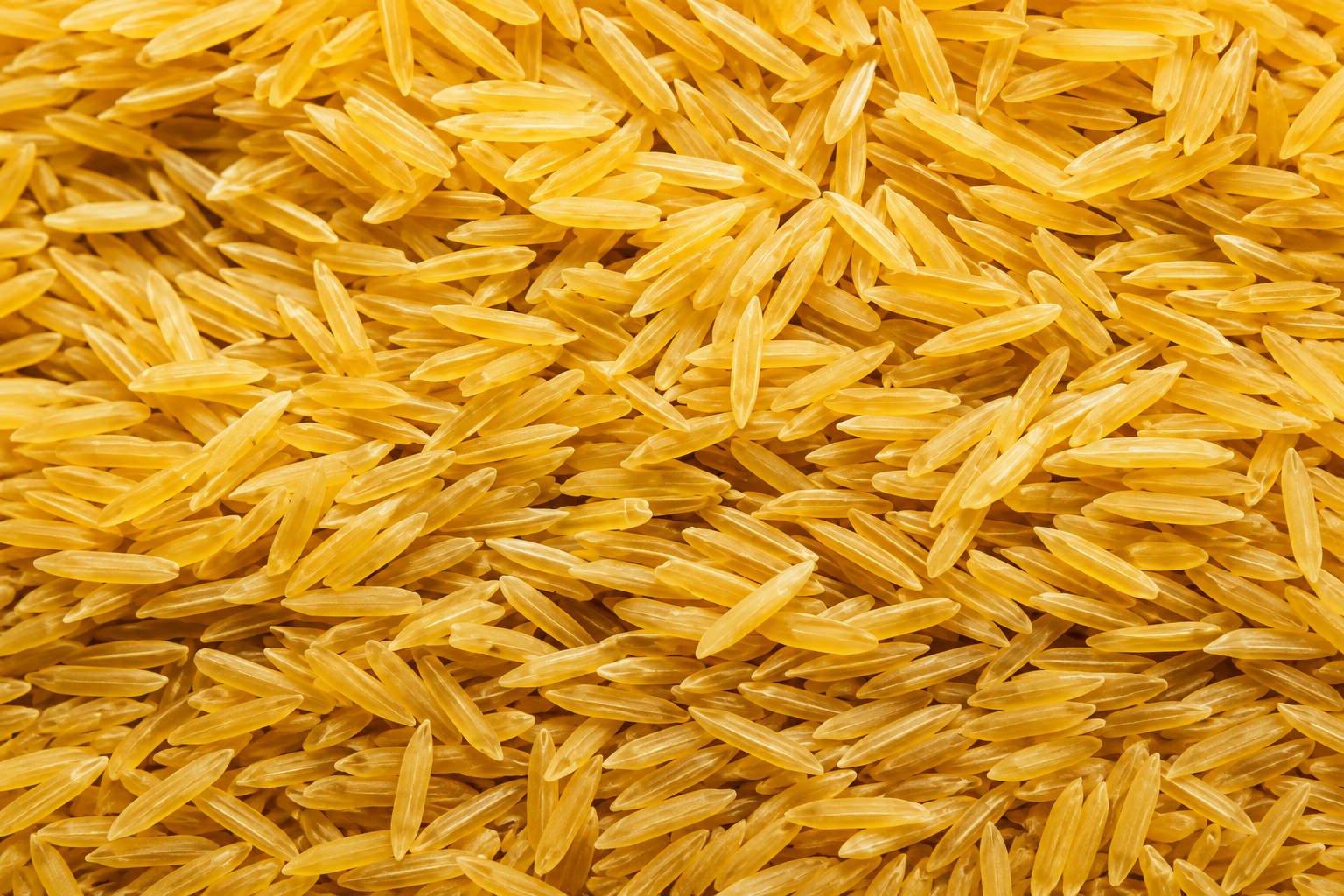
"Basmati" is not one product — it is a family of aromatic long-grain rice varieties grown in the Indo-Gangetic plains of Punjab, Haryana, Uttarakhand and western Uttar Pradesh. For importers, the difference between 1121 Basmati, Pusa Basmati and Traditional Basmati shows up in grain length, aroma, cooked elongation, cooking yield and — most visibly — in the FOB price. This guide compares the grades side by side so you can specify the right one for your market.
Quick comparison of Basmati rice grades
| Grade | Raw grain length | Cooked length | Aroma | Cooking yield | Typical use |
|---|---|---|---|---|---|
| 1121 Sella / Steam | 8.30 – 8.40 mm | 20 – 22 mm | High | Very high (2.5x) | GCC biryani, food service, retail premium |
| 1509 Basmati | 8.30 – 8.35 mm | 18 – 19 mm | Medium-high | High (2.3x) | Value biryani, HORECA, bulk contracts |
| Pusa Basmati (1401 / 1718) | 7.60 – 8.00 mm | 16 – 18 mm | Medium | High (2.2x) | Everyday retail, private label, blends |
| Traditional Basmati | 7.20 – 7.50 mm | 18 – 20 mm | Very high | Moderate (2.0x) | Connoisseur retail, gifting, aged premium |
| Sharbati / Sugandha | 7.00 – 7.20 mm | 14 – 16 mm | Low-medium | Moderate | Economy export, institutional catering |
1. 1121 Basmati — the export benchmark
Pusa 1121 is the longest-grain Basmati commercially grown in India, averaging 8.30–8.40 mm before cooking and elongating to 20–22 mm — close to a 2.5x expansion. That elongation is why it dominates biryani kitchens across the GCC, and why it commands the highest price among widely traded grades. It is exported as Raw, Steam, Golden Sella (parboiled) and White Sella. Golden Sella holds its shape best in high-volume catering; Steam suits retail packs where a softer, whiter grain is expected.
2. Pusa Basmati (1401, 1718, 1509) — value with consistency
The Pusa family was bred for yield and disease resistance, and it now supplies the bulk of mid-tier export volume. Grain length runs 7.60–8.35 mm depending on the variety, with moderate aroma and reliable cooking behaviour. For private-label retail programmes and institutional buyers who need a stable spec at a lower landed cost than 1121, Pusa grades are usually the correct answer. 1509 in particular has become a workhorse: nearly 1121's length, shorter crop duration, and a meaningfully lower FOB.
3. Traditional Basmati — aroma over length
Traditional (Dehraduni / Taraori / Basmati 370) varieties are shorter in the raw grain — around 7.20–7.50 mm — but carry the highest 2-acetyl-1-pyrroline content, the compound responsible for the classic Basmati aroma. Yields are lower and the plant is harder to farm, so pricing sits at or above 1121. Buyers serving connoisseur retail, gifting lines, or markets like the UK and parts of Europe where aroma outranks visual grain length should specify Traditional, ideally aged 12–24 months.
4. Ageing: why it changes the price
Basmati improves with controlled ageing. Fresh-crop rice holds more moisture, cooks stickier and elongates less. Aged rice — 12, 18 or 24 months in ventilated godowns — cooks drier, separates into individual grains and elongates further. Expect roughly a 5–12% price premium per ageing tier. Always confirm the crop year and ageing period on the contract, not just the variety name.
5. Standard export specification to request
Whichever grade you choose, hold your supplier to a written specification per lot:
- Average grain length and cooked elongation, measured and certified
- Moisture: 12.0% maximum (13.0% for Sella)
- Broken grains: 1–2% maximum for premium, 5% for standard
- Damaged / discoloured grains: 0.5% maximum
- Foreign matter: 0.1% maximum, double Sortex cleaned
- Chalky and immature grains: 2.0% maximum
- Pesticide residues within the destination market's MRLs (EU 396/2005 for Europe)
- Purity of variety: 93% minimum, DNA-verified where the buyer requires it
6. Processing types explained
- Raw — milled and polished only; most delicate aroma, highest breakage risk in cooking
- Steam — steamed then dried; whiter grain, firmer bite, popular in retail packs
- White Sella — parboiled then milled; creamy white, very firm, low breakage
- Golden Sella — parboiled with husk on; golden colour, maximum grain integrity for catering
7. Packing, MOQ and shipping
Basmati is exported in PP woven or non-woven bags of 5, 10, 20, 25 and 50 kg, jute bags for traditional markets, and BOPP printed retail packs of 1, 5 and 10 kg for private label. A 20' FCL carries roughly 26–27 MT; a 40' carries about 26 MT by volume in retail packs. Typical MOQ is one 20' FCL, with LCL trial lots possible. Loading ports are Mundra, Kandla and Nhava Sheva, with transit of about 7 days to Jebel Ali, 20–25 days to North Europe and 28–32 days to the US East Coast.
Which grade should you buy?
Choose 1121 Golden Sella for biryani-driven food service and premium GCC retail; Pusa 1509 or 1401 when landed cost matters and the spec must stay consistent across shipments; and Traditional Basmati, aged when your buyers value aroma and heritage over grain length. AmarBharat Exim supplies all three families with lot-wise third-party COA, crop-year declaration, and private-label packing.
Ready to source from India?
AmarBharat Exim handles end-to-end: sourcing, QC, documentation, packaging, and logistics.
Request a Quote